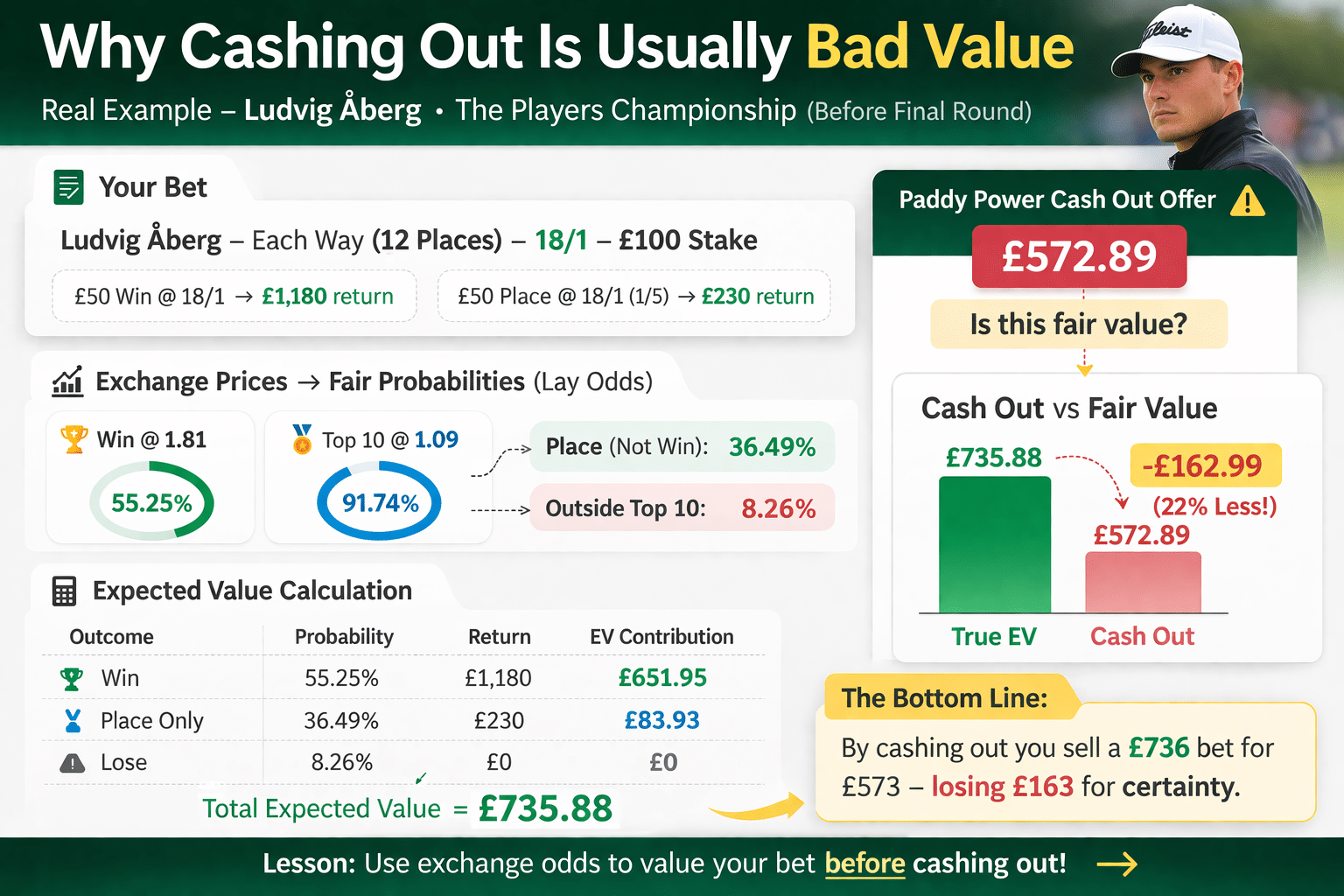
A Real Example – The Players Championship (Aberg)
One of the most common questions from bettors is whether they should cash out when their bet is in a strong position.
Bookmakers make this option look attractive, but in most cases the price offered is significantly below the true expected value of the bet.
The break between Round 3 and Round 4 at the Players Championship provides a good opportunity to test this using real market prices.
The Original Bet
Selection: Ludvig Åberg
Market: Each Way – 12 places (1/5 odds)
Odds: 18/1
Stake: £100 (£50 win + £50 place)
Potential returns if successful:
Win return: £1,180
Place-only return: £230
Paddy Power are offering a cash out of £572.89.
The question is:
Is £572.89 a fair value for the position the bet is currently in?
Using the Exchange as a Fair Market
At the pause before the final round the Betfair Exchange markets are relatively efficient, so they provide a reasonable proxy for fair probabilities.
Worst-case prices (using lay odds):
| Market | Lay Odds | Implied Probability |
|---|---|---|
| Winner | 1.81 | 55.25% |
| Top 10 | 1.09 | 91.74% |
Because our bet pays 12 places, using the Top 10 market is conservative (i.e. it underestimates the true place probability).
Step 1 – Probability of Outcomes
From the exchange prices:
Win probability
1 / 1.81 = 55.25%
Top 10 probability
1 / 1.09 = 91.74%
Therefore:
Place but not win probability
91.74 − 55.25
= 36.49%
Finish outside Top 10
100 − 91.74
= 8.26%
Step 2 – Expected Value of the Bet
We combine the probabilities with the potential returns.
Win outcome
Return = £1,180
EV contribution
55.25% × £1,180
= £651.95
Place only outcome
Return = £230
EV contribution
36.49% × £230
= £83.93
Lose outcome
Return = £0
EV contribution
8.26% × £0
= £0
Step 3 – Total Expected Value
Total EV:
£651.95
£83.93
= £735.88
Step 4 – Compare With the Cash Out
| Option | Value |
|---|---|
| Fair expected value | £735.88 |
| Paddy Power cash out | £572.89 |
Difference:
£162.99
This means the bookmaker’s offer is around:
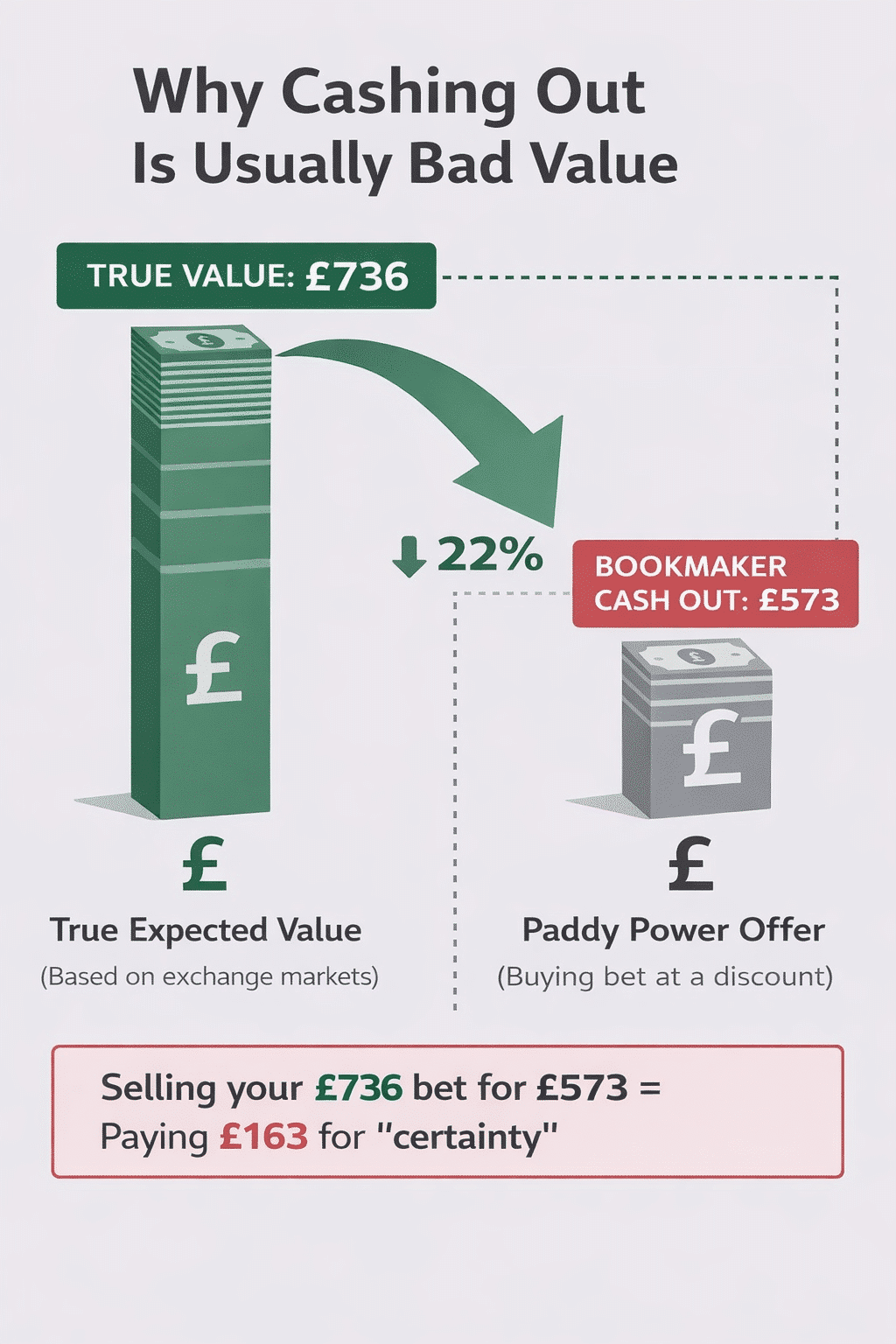
22% below the fair value of the bet.
And remember:
The calculation already uses conservative probabilities
The bet actually pays 12 places, not 10
So the real expected value is likely even higher.
Why Bookmakers Offer Cash Out
Cash out is effectively just:
The bookmaker buying your bet from you at a discounted price.
Reasons they promote it heavily:
Locks in profit for the bookmaker
Reduces volatility in their book
Many bettors prefer the certainty of a guaranteed return
But mathematically, the offer is typically well below fair value.
The Key Lesson
Using exchange markets to value a position shows:
True EV: ~£736
Cash out offer: £573
So by cashing out you are effectively selling a £736 asset for £573.
In other words, you are paying the bookmaker about £163 for the privilege of certainty. Not a great value insurance policy.